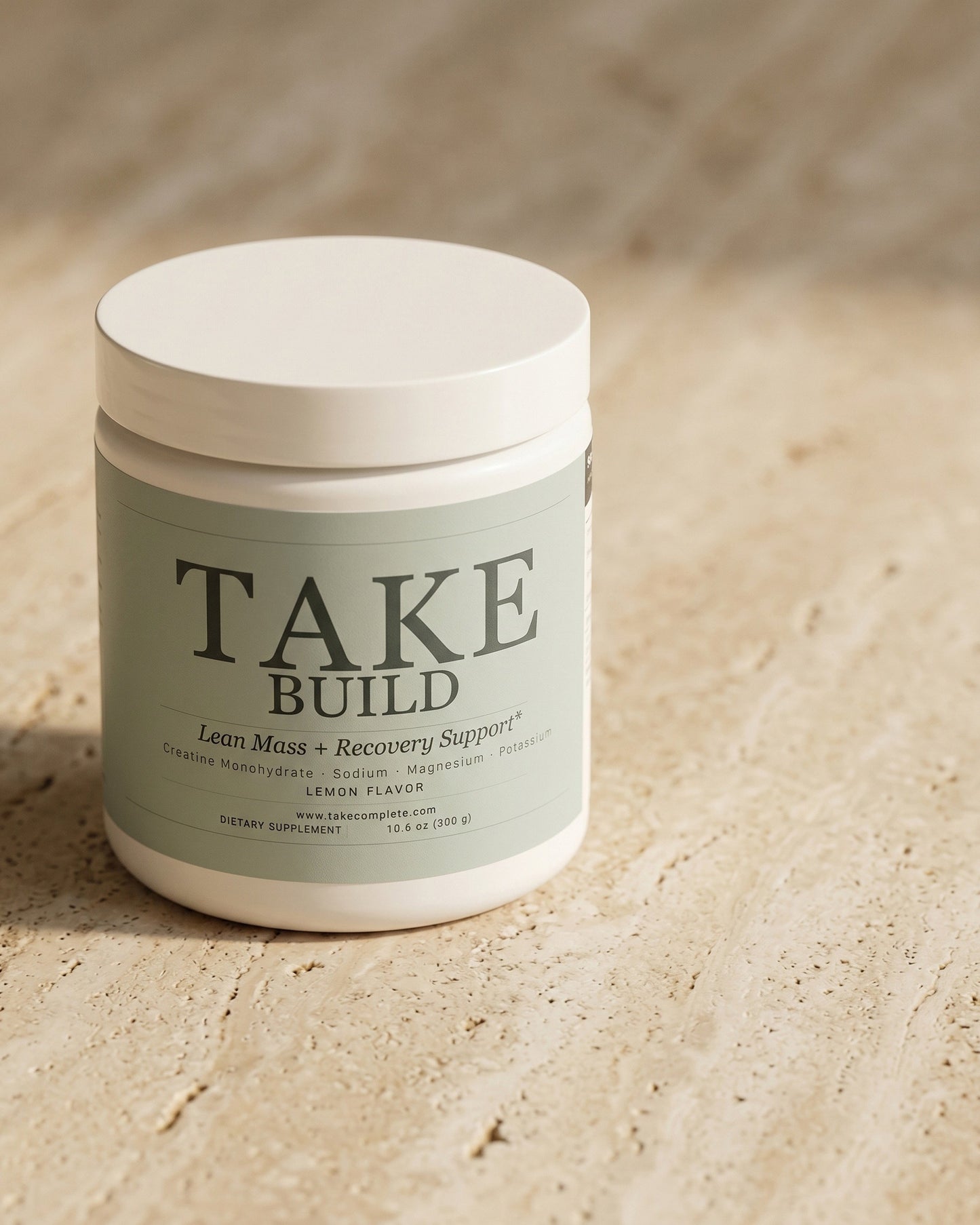
Across GLP-1 trials the share of weight lost as lean mass depends on the medication: about 26 percent on tirzepatide, and up to 45 percent on semaglutide, with a class-wide average near 30 percent and reported figures ranging from 20 to 50 percent.* Weight loss does not distinguish between fat and lean tissue. What you eat and how you move does. TAKE Build delivers 5,000mg of creatine monohydrate, the dose at which the evidence in women appears, alongside sodium, potassium and magnesium to support muscle function during GLP-1 treatment.*
The Medication Decides How Much You Lose.
GLP-1 medications suppress appetite and reduce caloric intake. Research consistently shows that when the body is in a significant caloric deficit, it does not burn fat exclusively. It draws on lean muscle alongside fat for fuel.
The share of total weight lost as lean mass depends on the medication: about 26 percent on tirzepatide (Mounjaro, Zepbound), and up to 45 percent on semaglutide (Ozempic, Wegovy), with a class-wide average near 30 percent and reported figures ranging from 20 to 50 percent.* If you are on semaglutide, you may be losing close to half your weight as lean mass; on tirzepatide, closer to a quarter. In the SURMOUNT-1 DXA substudy the placebo group lost the same ratio, 25 percent against 26 percent, so this is weight loss behaving as weight loss rather than the medication doing something unusual. It is also worth knowing that fat-free mass measured by DXA includes water, glycogen and connective tissue, so it is not skeletal muscle alone. A share of that size has consequences: for resting metabolic rate, for physical strength, for long-term weight management after stopping medication, and for body composition outcomes.
The medication decides how much you lose.It does not decide what.
The Research Was Built On Men
Creatine has been studied more than most nutritional ingredients, and the large majority of that research was done on men. Which is a strange place for the science to have started, because women hold roughly 70 to 80 percent less creatine than men do, and take in less of it from food.
The evidence in women is newer, and it is good. A meta-analysis published in June 2026 in the Journal of the International Society of Sports Nutrition pooled seven randomised, placebo-controlled trials covering 608 postmenopausal women, average age 62, running from 12 weeks to two years. Creatine improved lean mass and leg press strength against placebo.*
The size of the effect was modest and the authors say so plainly: 0.37kg of lean mass, and 7.5kg on a leg press strength test. We are not going to inflate those numbers for you. But modest is not nothing when the thing you are trying to influence is how much of your weight loss comes off as muscle.
Five Grams Is Not A Marketing Number
That same analysis found something worth knowing before you compare creatine products to each other.
The benefit appeared at 5 grams a day, taken alongside resistance movement. Trials using 3 grams or less, and trials using creatine without resistance movement, showed no measurable effect at all.
TAKE Build is 5,000mg. That is the dose the evidence sits on, and it is the reason this page has never told you creatine works on its own.*
Build Is One Of Three
Creatine monohydrate does not build or preserve muscle by itself, and we are not going to tell you it does. What it does is saturate muscle phosphocreatine stores, which is what supports the work that holds onto lean tissue.*
A review published in Metabolites in May 2026, looking specifically at lean mass preservation during GLP-1 treatment, placed creatine among adjunctive options supported mainly by indirect evidence, with protein intake and resistance exercise as the foundation. We agree with that ranking. It is why TAKE Nourish exists, and why Build has never been sold as the answer on its own.
Three things influence how much of what you lose is fat rather than muscle. Adequate protein. Resistance movement. And creatine to support that work.*
Build covers the third. TAKE Nourish covers the first. The second is yours, and it does not require a gym: bodyweight work, resistance bands, carrying things, stairs. The Strength System is the two of ours in one order, with electrolytes.
Why It's Different
5,000mg Creatine Monohydrate
The Dose Studied In Women
Sodium, Potassium, Magnesium
Made in an FDA-Registered US Facility
Ingredient Breakdown
Creatine Monohydrate 5,000mgThe form used in the large majority of published creatine research, and the dose at which benefits appear in the trials conducted in women. 5,000mg daily is the evidence-supported maintenance dose for saturating muscle phosphocreatine stores, and the dose used in long term tolerability research. The published research on this form spans several decades and covers muscle phosphocreatine saturation, strength measures, and long term tolerability in healthy adults.
Sodium 1,000mg, Potassium 200mg, Magnesium 60mgSodium as sea salt, potassium as potassium chloride, magnesium as magnesium malate, to support muscle function and hydration during GLP-1 treatment, when electrolyte intake from food is reduced.* Build carries ten times the sodium of TAKE Hydrate. If you are watching your sodium intake, that is a number worth knowing rather than discovering.
What Else Creatine Does, And Where That Stops
Creatine is studied well beyond muscle, and a good deal of what circulates about it online is ahead of the evidence. Here is where we think it honestly sits.
Safety, including kidneysThis is the question we are asked most. Across the seven trials in the 2026 analysis, adverse events were mild and no more common than in the placebo groups, and renal indices were unchanged. The wider literature agrees: no documented adverse effects on kidney, liver, gastrointestinal or cardiovascular function in healthy adults at these doses.
Weight on the scale, and bulkCreatine draws water into muscle cells rather than under the skin. Some people see one to two pounds appear in the first week or two. It is intracellular fluid, it is not fat, and it does not make women bulky. That last fear is the most common reason women avoid creatine and the research has never supported it.
Bone densityWe are not going to sell you Build for your bones. The 2026 analysis looked, and found bone mineral density unchanged overall across the trials. A single study suggested a slowing of loss at the femoral neck. That is interesting and it is not a claim.
Brain, memory and moodThere is real research here and it is genuinely contested. A 2023 meta-analysis found an effect on memory in healthy people. A 2024 systematic review argued the theoretical basis for a cognitive effect is not well supported. We are not making a claim in either direction. Anyone selling you creatine for your brain is further ahead of the evidence than we are willing to go.
Full Ingredient List
Every ingredient, per servingCreatine (as Creatine Monohydrate) 5,000mg, Magnesium (as Magnesium Malate) 60mg, Sodium (as Sea Salt) 1,000mg, Potassium (as Potassium Chloride) 200mg. 22 calories per serving. Other ingredients: Natural Flavors, Stevia Extract (Leaf), Silicon Dioxide. Sweetened with stevia. One scoop is 10g. 30 servings per tub. Lemon flavor. Manufactured in the United States, in an FDA-registered facility.
5,000mg creatine monohydrate. The dose the research in women actually uses.* Pairs with TAKE Nourish for protein, and with movement you choose.
Learn more: Why am I losing muscle on GLP-1 medications? | Why has my weight loss stopped on Ozempic? | Will I gain weight back when I stop Ozempic?
Common Questions
Is creatine safe for women?The evidence says yes. The June 2026 meta-analysis covering 608 women reported adverse events that were mild and no more frequent than placebo, with renal indices unchanged. Women also start from a lower base: endogenous creatine stores in women run roughly 70 to 80 percent below men's, and dietary intake is lower. If you are pregnant, nursing, or taking prescription medication, speak to your provider first.*
Will creatine make me bulky or gain weight?No. Creatine pulls water into the muscle cell rather than under the skin, so some people see one to two pounds on the scale early on. That is intracellular fluid, not fat. The idea that creatine makes women bulky is not supported by the research and never has been.
Is creatine bad for your kidneys?In healthy adults at 5,000mg daily, the research does not show kidney harm. Renal indices were unchanged across the trials in the 2026 analysis, and decades of tolerability research agree. If you have existing kidney disease or any medical condition affecting your kidneys, this is a conversation for your provider rather than a supplement label.
Should I take creatine if I am not exercising?Honestly, it will do less. In the 2026 analysis the benefit appeared when 5 grams a day was combined with resistance movement, and trials without it showed no measurable effect. Resistance movement does not mean a gym: bodyweight work, bands, carrying things, stairs. If none of that is possible right now, protein is the lever with the stronger evidence, and that is TAKE Nourish.*
Do you lose muscle on Ozempic?Across GLP-1 trials the share of weight lost as lean mass depends on the medication: about 26 percent on tirzepatide and up to 45 percent on semaglutide, with a class-wide average near 30 percent. In the SURMOUNT-1 DXA substudy the placebo group lost the same ratio, 25 percent against 26 percent.*
Will creatine stop me losing muscle?On its own, no, and we will not tell you otherwise. Creatine saturates muscle phosphocreatine stores, which supports the work that holds onto lean tissue. A May 2026 review of lean mass preservation during GLP-1 treatment placed creatine among adjunctive options supported mainly by indirect evidence, with protein and resistance exercise as the foundation. Build supports the third part of that picture.*
How much muscle loss is normal?Some lean mass loss is expected during any significant weight loss. Across GLP-1 trials the share of weight lost as lean mass runs about 26 percent on tirzepatide and up to 45 percent on semaglutide, with a class-wide average near 30 percent, which is why protein intake and staying active matter, and why your provider is the right person to ask.*
Consult your healthcare provider before starting if you are pregnant, nursing, taking medication, or have a medical condition. These statements have not been evaluated by the Food and Drug Administration. This product is not intended to diagnose, treat, cure, or prevent any disease.