GLP-1 101
Why Am I Nauseous on a GLP-1 Even When I Haven't Eaten?
You haven't eaten anything. So why does your stomach still have a complaint? GLP-1 nausea isn't necessarily caused by food — and an empty stomach may sometimes make things worse.
Free shipping at $80
GLP-1 101
You haven't eaten anything. So why does your stomach still have a complaint? GLP-1 nausea isn't necessarily caused by food — and an empty stomach may sometimes make things worse.

You haven't eaten breakfast.
You haven't even looked at breakfast.
And somehow your stomach has already decided it would like to speak to management.
It seems backwards. If food can trigger nausea, shouldn't an empty stomach solve the problem?
Not necessarily.
Nausea on a GLP-1 isn't simply your stomach reacting to something you ate. Current expert guidance notes that nausea can be particularly noticeable in the morning or after longer periods without food.
Which creates one of the more annoying GLP-1 paradoxes:
You feel too nauseous to eat. Going too long without eating may make you feel even more nauseous.
GLP-1 medications affect more than appetite.
Among their effects, they can slow gastric emptying, particularly earlier in treatment, and they interact with pathways involved in nausea and satiety.
That means nausea doesn't require a recent meal to show up.
In fact, the 2025 joint nutrition advisory on GLP-1 therapy specifically notes that nausea often occurs in the morning or after longer periods without eating.
So yes: your stomach can apparently have opinions about food even when there isn't any food in it.
More importantly, the advisory describes a frustrating cycle that can develop for some people:
Nausea makes you avoid food.
The longer stretch without eating can make the nausea harder to settle.
That makes eating even less appealing.
And around you go.
For some people, yes.
The 2025 joint advisory specifically describes people becoming caught in a cycle of not eating because they're nauseous, only for the nausea to worsen and make eating even less likely.
The practical recommendation isn't to sit down in front of an enormous breakfast and prove something.
Quite the opposite.
The guidance emphasizes smaller amounts of food at regular intervals, along with adequate fluids.
Think less “proper meal” and more “what can my stomach tolerate right now?”
Quick Take
An empty stomach doesn't necessarily mean a calm stomach.
GLP-1 nausea can occur in the morning or after longer periods without eating. For some people, avoiding food because they feel nauseous can create a cycle that makes eating increasingly difficult.
One possible explanation is simply the overnight stretch without food.
Current GLP-1 nutrition guidance specifically identifies the morning and longer periods without eating as times when nausea may occur.
That doesn't mean everyone needs to wake up and immediately eat a full breakfast.
If your appetite is tiny, a small amount may be more realistic.
The point is not to win breakfast.
It's to give your stomach less to argue about.
When your stomach says no
There isn't one perfect GLP-1 nausea routine. But current expert guidance does offer several practical strategies that may make eating and drinking easier while symptoms settle.
If long stretches without food seem to make your nausea worse, smaller amounts at more regular intervals may be easier than waiting until you feel hungry enough for a full meal.
The 2025 joint advisory discusses breakfast followed by small meals approximately every three to four hours for people caught in the nausea-not-eating cycle.
This isn't a rule everyone has to follow. It's a practical option when long stretches without food seem to be part of the problem.
When nausea is active, smaller portions and simpler foods may be easier to tolerate than a large meal.
This is probably not the moment for the enormous kale salad you bought while feeling wildly optimistic on Sunday.
Your nutritional life will survive one imperfect meal.
Nausea can make drinking less appealing too.
Small, frequent sips may feel more manageable than trying to finish a huge glass of water all at once.
Hydration deserves even more attention if nausea progresses to vomiting or diarrhea, because fluid losses can increase.
The goal is hydration, not winning an imaginary water-drinking competition.
Current expert guidance suggests temporarily reducing particularly fatty or high-fibre foods when nausea is troublesome; the 2025 joint advisory mentions this particularly early in treatment.
That doesn't make fat or fibre “bad.”
It means the strategy can change when your GI tract is already unhappy.
Once symptoms settle, your normal nutritional priorities still matter.
The 2025 joint advisory includes ginger or peppermint tea among practical strategies that may help some people manage nausea.
Acupressure bands are also discussed.
These are supportive options, not a substitute for medical evaluation when nausea is severe or persistent.
Fibre can be useful for constipation.
But nausea is not constipation.
When you're already nauseous, increasing fibre dramatically isn't automatically helpful, and current guidance actually suggests temporarily avoiding very high-fibre foods when nausea is troublesome.
Your digestive tract does not appreciate a one-size-fits-all wellness hack.
Whatever you can comfortably keep up with matters more than creating the perfect hydration routine.
Water is an obvious starting point.
Small, frequent sips may be easier when you're nauseous than drinking a large amount at once.
If you're also vomiting or experiencing diarrhea, fluid and electrolyte losses become more relevant.
Current GLP-1 supportive-care guidance emphasizes adequate hydration during nausea and vomiting and particularly when vomiting, diarrhea or fasting are involved.
That doesn't mean everyone with mild nausea needs an electrolyte drink.
It does mean hydration deserves attention when eating and drinking less — especially if you're also losing fluids.
Hydration Note
Nausea can affect what you drink, too.
If you're drinking less because you feel nauseous, small frequent sips may be easier. Vomiting or diarrhea can increase fluid and electrolyte losses, making hydration particularly important.
An electrolyte drink supports fluid and electrolyte intake; it does not treat nausea itself.
Often, it improves.
The expert consensus literature describes GI side effects as commonly appearing during treatment initiation or dose escalation and often becoming less frequent or less intense after time at a stable dose.
But “common” and “temporary” do not mean you have to quietly suffer through severe symptoms.
If nausea is making it difficult to eat or drink, keeps returning, becomes worse, or is accompanied by repeated vomiting, contact your healthcare professional.
And don't independently change your medication dose because your stomach had a bad Tuesday.
Your prescriber can help determine whether the symptom is expected, whether something else may be contributing and whether your treatment plan needs to change.
Mild nausea that settles is one thing.
Symptoms that prevent you from eating or drinking adequately are another.
Contact your healthcare professional if nausea is severe, persistent or worsening; if you're vomiting repeatedly; if you can't keep fluids down; if you develop signs of dehydration; or if something simply feels substantially different from the usual side effects you've experienced.
Nausea can have causes unrelated to GLP-1 treatment too, so persistent symptoms shouldn't automatically be blamed on the medication.
And if you're considering changing, delaying or stopping a prescribed dose because of side effects, talk with your prescriber rather than adjusting it on your own.
There is no prize for suffering silently through a medication side effect.
Feeling nauseous when you haven't eaten isn't as contradictory as it sounds.
GLP-1 medications affect gastrointestinal function, and current expert guidance notes that nausea may occur in the morning or after longer periods without food.
For some people, not eating because they feel nauseous can create an irritating loop: nausea makes eating harder, and going longer without eating may make the nausea harder to settle.
Smaller amounts of food at regular intervals, adequate fluids, temporarily adjusting very fatty or high-fibre foods and strategies such as ginger or peppermint may help some people while symptoms settle.
Hydration becomes particularly important if vomiting or diarrhea enter the picture.
And if you're struggling to eat or drink, vomiting repeatedly, becoming dehydrated, or dealing with nausea that is severe, worsening or persistent, that's no longer a “maybe I'll try some ginger tea” situation.
Talk to your healthcare professional.
Mozaffarian D, et al. Nutritional priorities to support GLP-1 therapy for obesity: A joint advisory from the American College of Lifestyle Medicine, the American Society for Nutrition, the Obesity Medicine Association, and The Obesity Society. Obesity Pillars. 2025;15:100181. doi:10.1016/j.obpill.2025.100181.
https://pmc.ncbi.nlm.nih.gov/articles/PMC12264624/
Gorgojo-Martínez JJ, et al. Clinical Recommendations to Manage Gastrointestinal Adverse Events in Patients Treated with GLP-1 Receptor Agonists: A Multidisciplinary Expert Consensus. Journal of Clinical Medicine. 2022;12(1):145. doi:10.3390/jcm12010145. PMID: 36614945.
https://pmc.ncbi.nlm.nih.gov/articles/PMC9821052/
Sievenpiper JL, et al. Nutritional and lifestyle supportive care recommendations for management of obesity with GLP-1-based therapies: An expert consensus statement using a modified Delphi approach. Obesity Pillars. 2025;17:100228. doi:10.1016/j.obpill.2025.100228. (Consensus statements primarily derived from indirect evidence and clinical experience rather than direct randomized trials.)
https://pmc.ncbi.nlm.nih.gov/articles/PMC12768930/
The Appendix provides general educational information and is not a substitute for individualized medical advice. Speak with your healthcare professional about questions specific to your health, medications or treatment.
TAKE next
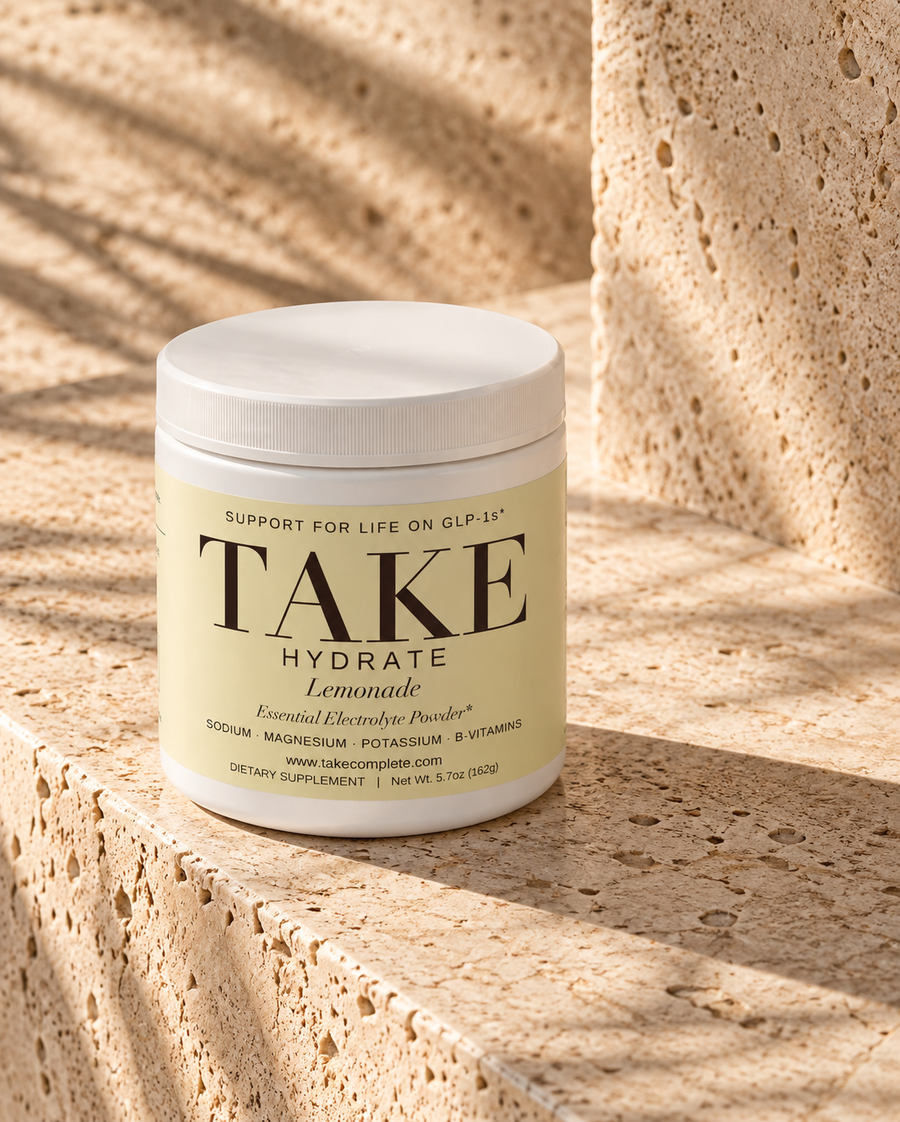
When drinking enough feels like a job.
Nausea can make fluids harder to keep up with, while vomiting or diarrhea can increase fluid and electrolyte losses.
HYDRATE
Electrolytes including sodium, potassium and magnesium, plus B vitamins, in an easy-to-sip drink for the days when paying attention to hydration matters a little more.*


