The Research
Why Is My Hair Shedding More After Losing Weight on a GLP-1?
More hair in the shower after significant weight loss? Hair loss has been reported during GLP-1 treatment, but the medication itself may not be the whole story.
Free shipping at $80
The Research
More hair in the shower after significant weight loss? Hair loss has been reported during GLP-1 treatment, but the medication itself may not be the whole story.

It starts innocently enough.
A few extra hairs in the shower.
Then your brush gets involved.
Then one morning you're standing there holding what appears to be enough hair to build a small emotional-support hamster.
Cool.
Hair shedding after significant weight loss is real.
And if it happens while you're taking a GLP-1, the obvious conclusion is:
The medication is making my hair fall out.
Maybe.
But that isn't the only explanation, and right now the research doesn't let us say it's that simple.
Hair loss has been reported in clinical trials of semaglutide and tirzepatide used for weight management.
At the same time, significant and rapid weight loss itself is a recognized trigger for a type of diffuse shedding called telogen effluvium.
Translation:
Your hair may be reacting to what your body has been through, not necessarily to one ingredient in your injection.
Let's untangle it.
Yes.
Hair loss appears in current prescribing information for both Wegovy and Zepbound.
That means this is not something people collectively invented on the internet.
In adult weight-management trials included in current Wegovy prescribing information, hair loss was reported more frequently with semaglutide 2.4 mg than placebo.
Current Zepbound prescribing information also reports hair loss, particularly among female participants.
And there is an especially important sentence in BOTH labels:
the hair-loss adverse reactions were associated with weight reduction.
That wording matters.
Because “hair loss happened during treatment” and “the medication directly damaged the hair follicle” are not the same scientific claim.
The signal appears there too.
In pooled Zepbound weight-reduction trials, hair loss was reported more often among female participants receiving tirzepatide than female participants receiving placebo.
Again, the prescribing information specifically says the hair-loss reactions were associated with weight reduction.
That does not prove weight loss explains every case.
But it is a pretty important clue.
Annoyingly, science has selected:
“We're still working on that.”
There is growing evidence of an association between GLP-1-based medications and hair loss, particularly with semaglutide and tirzepatide.
But association is not the same thing as knowing the mechanism.
Current evidence includes clinical-trial adverse-event reporting, pharmacovigilance data and observational research.
What we do not yet have is a clean answer showing that every case of shedding during treatment is caused directly by the medication itself.
One plausible contributor is the weight loss.
Significant weight loss is a physiologic change.
And one way the hair follicle can respond to a significant physiologic stressor is through telogen effluvium.
Which brings us to the term you're about to become annoyingly familiar with.
Quick Take
Hair shedding doesn't automatically mean permanent hair loss.
Telogen effluvium is a type of diffuse, non-scarring hair shedding that can occur after a physiologic stressor, including significant or rapid weight loss.
It is different from hair-loss disorders that permanently damage the follicle.
Not every case of hair loss during GLP-1 treatment is telogen effluvium. A clinician or dermatologist can help determine the pattern when the cause is unclear.
Your hair follicles do not all grow continuously.
They move through phases.
A growing phase.
A transition.
A resting phase.
And eventually:
shedding.
With telogen effluvium, a larger-than-usual number of hairs can shift toward the resting/shedding part of that cycle after the body experiences a significant stressor.
Possible triggers include major illness, surgery, childbirth, substantial weight loss and other physiologic stresses.
The result is usually diffuse shedding rather than one perfectly bald patch.
And the particularly rude part?
The shedding may not begin when the trigger happens.
It can show up later.
Because hair is extraordinarily unhelpful about providing timely feedback.
Your body experiences the stressor.
Your hair waits.
Then months later it submits its complaint.
Telogen effluvium reflects the hair-growth cycle, which means increased shedding can become noticeable weeks to months after the event that helped trigger it.
This delayed timing is one reason people may have been losing weight successfully for months before suddenly noticing considerably more hair in the shower.
It also means:
“I've been on this medication for months, so it can't possibly be related”
isn't necessarily a safe conclusion.
But neither is:
“It started four months later, so the medication definitely caused it.”
Timing is a clue.
Not a diagnosis.
The Timing Is a Clue
Telogen effluvium often appears after a delay because hair follicles move through a cycle.
Timing varies, and not every case of hair shedding after weight loss is telogen effluvium.
There is no magic number where your hair suddenly files a complaint.
But researchers have looked at people who developed telogen effluvium after weight loss.
A 2024 retrospective dermatology study included 140 patients diagnosed with weight-loss-associated telogen effluvium.
On average, those patients had lost about 15.2% of their body weight at an average rate of approximately 3.54 kilograms per month.
Before you open the calculator:
those are averages from people who ALREADY HAD telogen effluvium.
They are not thresholds.
The study does not mean:
“Lose 15% and your hair will fall out.”
It means significant and relatively rapid weight loss was present in this particular group of patients with weight-loss-associated shedding.
That's useful evidence.
It is not a prediction tool.
Potentially.
When appetite becomes much smaller, the amount of food — and therefore nutrients — coming in can change substantially.
Hair is not the body's highest-priority project.
If nutritional intake becomes inadequate, deficiencies or insufficient intake may contribute to hair problems in some people.
Protein matters.
Iron status can matter.
Other nutritional deficiencies can matter.
But this is where the internet becomes dangerous very quickly.
Hair shedding does NOT mean:
“You are definitely deficient in iron.”
It does NOT mean:
“You need huge doses of biotin.”
It does NOT mean:
“Buy every supplement with a picture of hair on the bottle.”
If nutritional deficiency is a concern, the useful question is what your actual diet, symptoms, medical history and, where clinically appropriate, testing show.
Guessing is considerably less useful.
Please Don't Panic-Supplement
More is not automatically better.
Seeing hair in the shower has a remarkable ability to turn a reasonable adult into someone prepared to order 14 supplements before breakfast.
Some nutrient deficiencies can contribute to hair loss.
That does not mean every person with shedding has the same deficiency or that high-dose supplementation is harmless.
Bottom line: Look for the reason before trying to supplement your way out of it.
Start here
Not what you intended to eat.
Not what you used to eat.
What you are actually getting now.
If your appetite has become dramatically smaller, nutritional adequacy deserves attention.
Adequate protein matters during weight loss for more than one reason.
If smaller portions are making protein difficult to fit in, look for practical ways to include it across the day rather than attempting to repair the entire situation at dinner.
Iron deficiency can contribute to hair loss.
So can other medical and nutritional issues.
If the shedding is significant or persistent, your healthcare professional can decide whether your history or symptoms justify testing.
Your bathroom drain cannot order bloodwork.
While you're shedding, this may not be the ideal moment for:
Gentle hair care does not address every possible cause of shedding.
But avoiding unnecessary additional damage is reasonable.
Same part.
Same lighting.
Same approximate angle.
Every few weeks.
Not twelve times a day.
Hair changes slowly.
Your bathroom mirror is not a calibrated clinical instrument.
Especially at 11 p.m.
Hair recovery does not operate on skincare timelines.
When telogen effluvium is the cause and the trigger resolves, shedding may improve over time.
But hair growth is slow.
You are not going to evaluate recovery accurately by checking your part every morning for four days.
Diffuse shedding across the scalp fits telogen effluvium more closely than some other patterns.
Patchy loss, scalp inflammation, scarring or other unusual changes deserve a different conversation.
If the shedding is telogen effluvium and the underlying trigger has resolved, the outlook is generally reassuring because the follicles are not typically permanently destroyed.
But recovery takes time.
Shedding may take months to settle.
Visible density can take longer because new hair has to actually grow.
This is one of those deeply unsatisfying medical answers where:
“give it time”
is both annoying and sometimes accurate.
However:
Persistent or unusual hair loss should be evaluated.
The Annoying Part
Hair recovery is measured in months, not Tuesdays.
When telogen effluvium is the cause, the follicle is generally still capable of producing hair.
But shedding has to settle and new hair then needs time to grow.
Bottom line: Progress can be real before it is dramatic.
Diffuse shedding is one thing.
Other patterns deserve evaluation.
Talk with a healthcare professional or dermatologist if you notice:
Do not automatically assume every change in your hair is from weight loss or your GLP-1.
There are many causes of hair loss.
The point of knowing about telogen effluvium isn't to diagnose yourself.
It's to understand why significant weight loss belongs on the list of things worth discussing.
That is a conversation for you and the clinician managing your prescription.
Hair loss can be upsetting.
So can the idea of changing a treatment that may otherwise be helping you.
The useful move is not to independently stop, skip or alter prescribed medication based on what you found in the shower.
Bring the shedding to your healthcare professional.
Bring the timing.
Bring your weight-loss history.
Bring any changes in food intake.
Bring other symptoms.
And if you took those boring same-lighting photos?
Bring those too.
A pattern is considerably more useful than panic.
Hair shedding during GLP-1 treatment is real enough to appear in current semaglutide and tirzepatide prescribing information.
But that does not mean we've proven that the medication itself directly causes every case.
The FDA labels describe these hair-loss reactions as associated with weight reduction, and significant or rapid weight loss is already a recognized trigger for telogen effluvium.
Newer observational research also suggests an association between GLP-1 treatment and nonscarring hair loss, but the mechanism is still being worked out.
So if your shower drain suddenly looks considerably busier than it used to:
don't panic-supplement.
Look at your actual nutrition.
Make protein count.
Be gentle with your hair.
Pay attention to the pattern.
Take a few boring, consistent photos.
And if the shedding is significant, persistent, unusual or worrying you, bring it to a healthcare professional or dermatologist.
Because yes:
your hair may simply be reacting to a major change your body has been through.
But you deserve a better answer than:
“It's probably the GLP-1.”
And the emotional-support hamster can stay hypothetical.
U.S. Food and Drug Administration. WEGOVY (semaglutide) prescribing information. Novo Nordisk. Revised 6/2026. Section 6.1: in pooled adult studies, hair loss 3.3% with WEGOVY 2.4 mg (4% female, 0.9% male) vs 1% with placebo (2% female, 0 male); hair-loss adverse reactions were associated with weight reduction.
https://dailymed.nlm.nih.gov/dailymed/drugInfo.cfm?setid=ee06186f-2aa3-4990-a760-757579d8f77b
U.S. Food and Drug Administration. ZEPBOUND (tirzepatide) prescribing information. Eli Lilly and Company. Revised 8/2026. Section 6.1: in a pool of Study 1 and Study 2, hair loss 7.1% female vs 0.5% male with ZEPBOUND and 1.3% female vs 0% male with placebo; hair-loss adverse reactions were associated with weight reduction.
https://dailymed.nlm.nih.gov/dailymed/drugInfo.cfm?setid=487cd7e7-434c-4925-99fa-aa80b1cc776b
Kang DH, Kwon SH, Sim WY, Lew BL. Telogen Effluvium Associated With Weight Loss: A Single Center Retrospective Study. Annals of Dermatology. 2024;36(6):384–388. doi:10.5021/ad.24.043. PMID: 39623615.
https://pmc.ncbi.nlm.nih.gov/articles/PMC11621640/
Piraccini BM, Vañó-Galván S, Blume-Peytavi U, Ribet V, Mengeaud V. Hair Loss in Patients on Glucagon-Like Peptide 1 Receptor Agonists: Understanding Risks and Managing Outcomes. Dermatology and Therapy. 2026;16(7):3345–3360. doi:10.1007/s13555-026-01792-0. PMID: 42249225. (Review.)
https://pubmed.ncbi.nlm.nih.gov/42249225/
Gupta AK, Teasell EM, Economopoulos V, Mirmirani P. GLP-1 therapies and hair loss: A systematic review of current evidence and implications for counseling. Science Progress. 2026;109(2). doi:10.1177/00368504261444578. (Systematic review including clinical-trial and pharmacovigilance evidence.)
https://pmc.ncbi.nlm.nih.gov/articles/PMC13100445/
Katragadda R, Hayden J, Saltagi AK, et al. Nonscarring Alopecia in Adults Treated With GLP-1s: A Propensity Score Matched TriNetX Cohort Study. The Laryngoscope. 2026. doi:10.1002/lary.70810. PMID: 42647098. (Observational cohort study.)
https://pubmed.ncbi.nlm.nih.gov/42647098/
American Academy of Dermatology Association. Do you have hair loss or hair shedding?
https://www.aad.org/public/diseases/hair-loss/insider/shedding
Chang FLC, Oakley A. Telogen effluvium. DermNet.
https://dermnetnz.org/topics/telogen-effluvium
The Appendix provides general educational information and is not a substitute for individualized medical advice. Speak with your healthcare professional about questions specific to your health, medications or treatment.
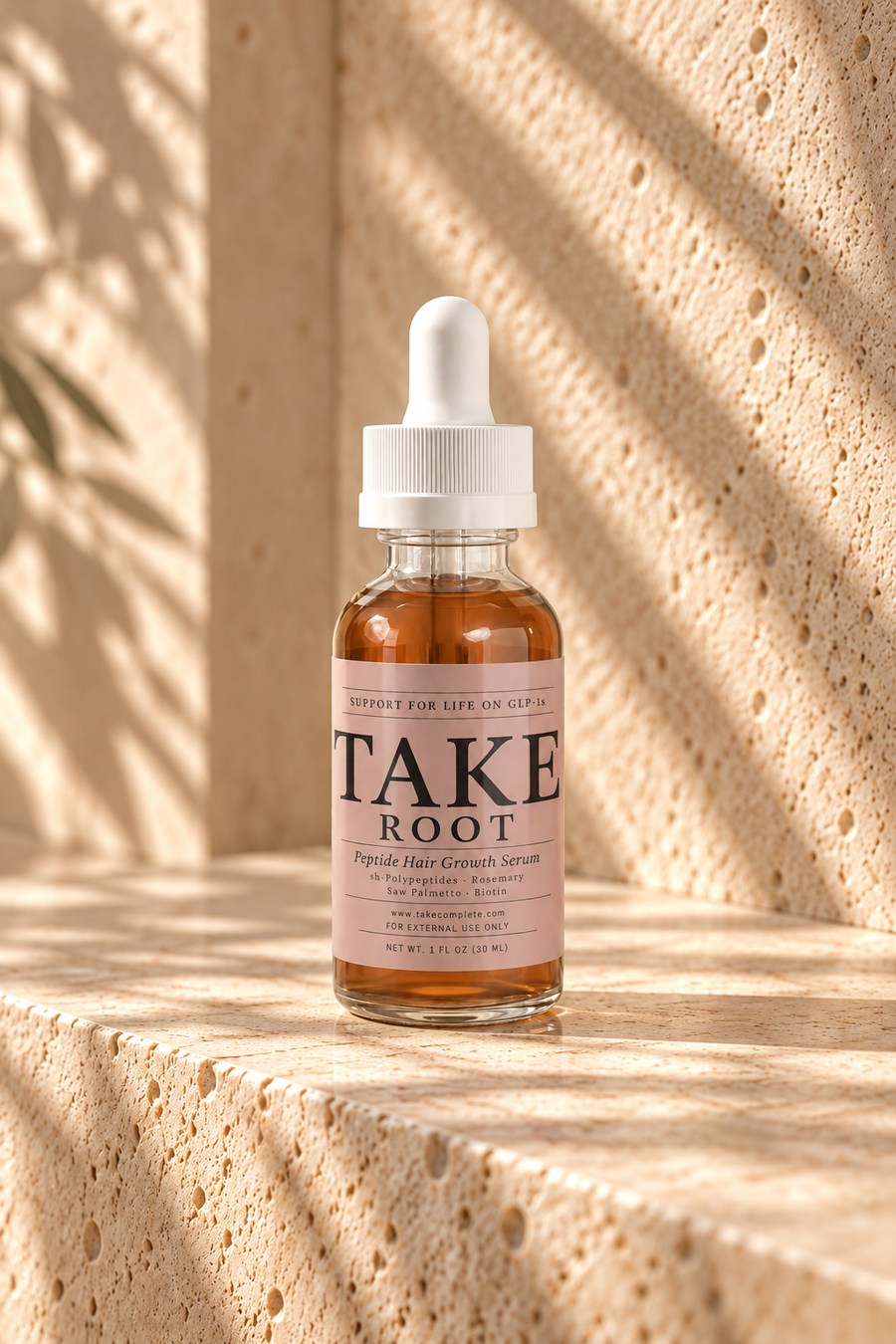
TAKE next
Give your scalp a routine of its own.
When your hair is going through a shedding phase, the bigger picture matters: nutrition, the pace of weight loss, your overall health and how you care for your hair and scalp.
ROOT
A lightweight nightly scalp serum with an sh-Polypeptide & sh-Oligopeptide Complex, rosemary and saw palmetto, plus arginine, eucalyptus and botanical extracts, created to support a consistent scalp-care routine during periods of hair change.*
Individual results may vary. Everyone responds differently to cosmetic ingredients, and results cannot be guaranteed.


